


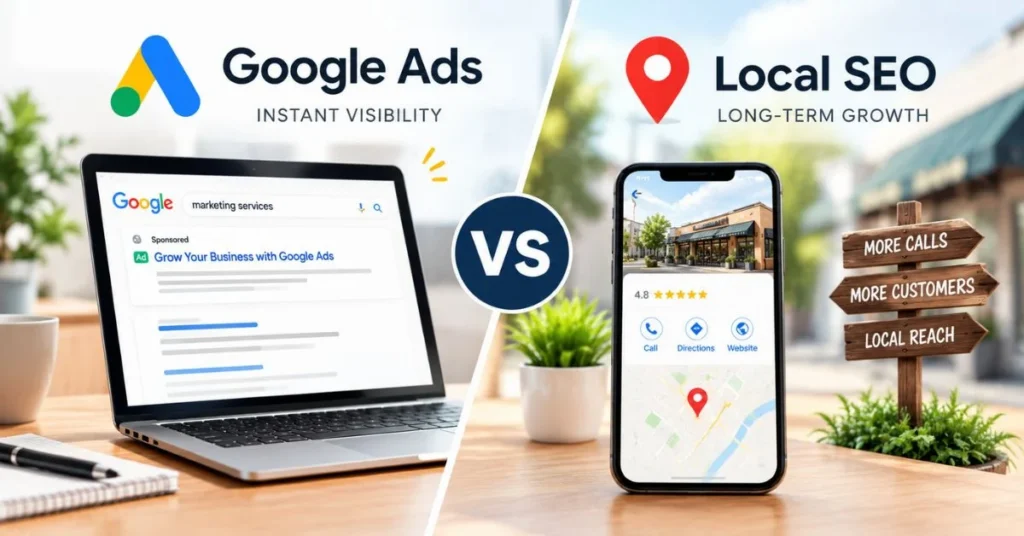
A Miami business with a limited marketing budget eventually faces the same question most local businesses face: should the next dollar go toward Google Ads or toward local SEO? Both channels can put a business in front of nearby customers actively searching for what it offers, but they work in different ways, cost money differently, and pay off on different timelines. Understanding these differences matters more in a market as competitive as Miami, where dense local competition affects both channels significantly.
This guide compares Google Ads and local SEO specifically for Miami businesses, covering real cost benchmarks, how quickly each channel produces results, and which situations favor one over the other.
Why This Decision Matters More in Miami
Miami’s business density, combined with its mix of tourism, international buyers, and intense competition in categories like real estate and legal services, affects both channels in specific ways. Paid search auctions in Miami tend to run more expensive than in less competitive metro areas, while local SEO has to compete against an unusually large number of nearby businesses chasing the same map pack visibility. Neither channel offers an easy shortcut in this market, which makes an honest comparison worth the time before committing budget to either one.
How Google Ads Works for a Miami Business
Google Ads puts a business at the top of search results immediately, with visibility that begins the moment a campaign launches rather than building gradually over months. For a Miami business needing leads quickly, whether to fill a slow season or launch a new service, this immediacy is the format’s biggest advantage. The overview of paid advertising services shows how a campaign typically gets structured, from keyword targeting to ongoing bid management.
The tradeoff is that visibility stops the moment spending stops. A Miami business running Google Ads needs to treat the budget as an ongoing cost of generating leads, not a one-time investment that keeps paying off after the campaign ends.
How Local SEO Works for a Miami Business
Local SEO focuses on earning visibility in the organic map pack and search results through an optimized Google Business Profile, consistent citations, reviews, and location-specific content. Google states that local results are based primarily on relevance, distance, and prominence, which includes reviews, and that there is no way to pay for a better local ranking directly.
Unlike Google Ads, local SEO visibility tends to persist even without ongoing spend, since a well-optimized profile and strong review history continue working in the background. The tradeoff is time, since local SEO in a competitive market like Miami typically takes one to three months to show meaningful movement after a profile is fully optimized, longer than the near-immediate results Google Ads provides.
Comparing Real Costs: What Each Channel Actually Costs
The average cost per click on Google Ads across industries reached $5.42 in 2025, up from $4.66 the year before, according to benchmark data from WordStream by LocaliQ covering more than 16,000 campaigns. Costs vary considerably by industry, with categories like legal services running significantly higher than the average, which matters directly for Miami given how competitive legal and real estate advertising is in this market. Average cost per lead across industries sat at $70.11 in the same report, giving a rough sense of what a single qualified lead costs through paid search.
Local SEO does not carry a per-click cost in the same way, but it requires ongoing investment in profile management, review generation, and content, along with patience while rankings build. A business comparing the two should think in terms of total monthly investment and expected lead volume for each, rather than assuming one channel is simply cheaper than the other in every case.
Comparing Speed: Immediate Visibility vs Gradual Growth
Google Ads wins decisively on speed, generating clicks and leads within hours of a campaign going live. This makes it the better choice for a Miami business with an urgent, time-sensitive need, such as filling appointment slots during snowbird season or promoting a limited-time offer.
Local SEO takes longer by design, since Google needs time to crawl, index, and build trust in a business’s profile and website before ranking it prominently. A Miami business with no urgent timeline and the patience to invest consistently over several months tends to benefit more from prioritizing this slower but more durable channel.
Comparing Long-Term Value
This is where local SEO tends to pull ahead. A well-optimized Google Business Profile and a library of location-specific content keep generating visibility and leads long after the initial work is done, while Google Ads visibility disappears the moment a campaign budget runs out. Over a multi-year horizon, many Miami businesses find that local SEO produces a lower effective cost per lead than sustained Google Ads spend, even though the upfront timeline is slower.
That said, a business that has let its local SEO lapse for years cannot expect to catch up overnight, which is part of why many businesses lean on Google Ads to generate leads while local SEO work builds in the background.
Which Miami Businesses Lean Toward Each Channel
Businesses in highly competitive, high-value categories like real estate, legal services, and medical aesthetics often use Google Ads heavily, since the cost per lead, while higher, can still make sense against a high-value transaction. Service businesses with a strong local footprint, such as restaurants, home services, and personal care providers, often see stronger returns from local SEO, since these categories rely heavily on nearby search and map pack visibility rather than one-time, high-value transactions.
Reviewing how a pay-per-click campaign gets built for a different competitive market like San Diego and how an SEO agency approaches dominating search results in a similarly competitive city shows how this same decision plays out in another dense metro market.
Why Many Miami Businesses Eventually Use Both
Most established Miami businesses eventually run both channels together rather than choosing one permanently. Google Ads fills the gap while local SEO is still building, and once local SEO matures, Google Ads budget can often shrink without a proportional drop in total leads, since organic visibility is now carrying more of the load. The overview of SEO services alongside paid advertising shows how these two channels typically get coordinated rather than run in isolation.
Making the Right Choice for a Specific Business
A Miami business with an urgent, immediate need and budget to spend should lean toward Google Ads first. One with a longer runway and the patience to invest consistently should prioritize local SEO, knowing that Google Ads can still fill gaps along the way. A team such as Premier Marketing that manages both channels together, rather than treating them as competing options, tends to help a Miami business sequence this investment more effectively than committing entirely to one channel from the start.
Frequently Asked Questions
1. Is Google Ads or local SEO better for a Miami business?
It depends on timeline and budget, since Google Ads produces faster results while local SEO builds slower but more durable, lower-cost visibility over time.
2. How much does Google Ads cost on average?
The average cost per click across industries was $5.42 in 2025, with significant variation by industry, according to WordStream benchmark data.
3. How long does local SEO take to work in Miami?
Local SEO in a competitive market like Miami typically takes one to three months to show meaningful movement after a profile is fully optimized.
4. Can a small Miami business afford both Google Ads and local SEO?
Many businesses start with one channel based on budget and urgency, then add the other once initial results justify expanding the investment.
5. Which Miami industries benefit most from Google Ads?
High-value, competitive categories like real estate, legal services, and medical aesthetics often see strong returns from Google Ads despite higher cost per click.