


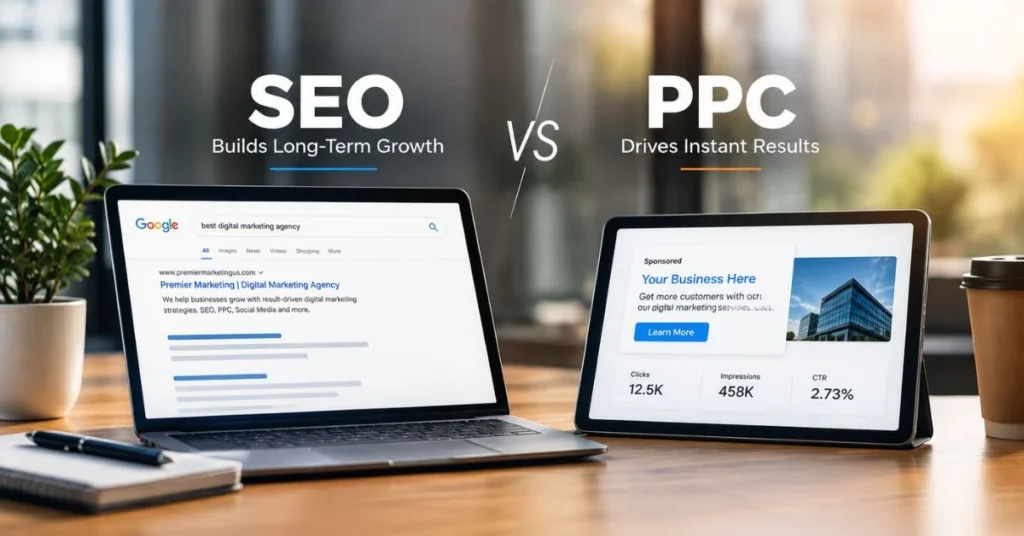
Texas is home to roughly 3.5 million small businesses, accounting for 99.8 percent of all businesses in the state and 5.1 million jobs, according to the Small Business Administration’s Office of Advocacy 2025 state profile. That density means a Texas small business rarely competes against just one or two local rivals, which makes the choice between SEO and PPC, search engine optimization and pay-per-click advertising, matter even more for a budget that has to work hard.
This guide compares the real costs and tradeoffs of SEO and PPC specifically for Texas small businesses, covering what each channel actually costs, how quickly each pays off, and how to decide where a limited budget should go first.
What SEO Actually Costs for a Small Business
SEO costs typically come in the form of an ongoing monthly investment covering technical optimization, content creation, and local search management rather than a cost per click. For a Texas small business, this often means paying for consistent work over several months before meaningful ranking improvements appear, since search engines need time to crawl, index, and build trust in new or updated content.
The overview of SEO services shows how this investment typically breaks down across technical fixes, on-page optimization, and local SEO work. A guide on how Texas local businesses can rank higher on Google covers what this looks like applied specifically to this market.

What PPC Actually Costs for a Small Business
PPC costs scale directly with clicks and conversions, making the cost structure more immediately visible than SEO’s ongoing monthly investment. The average cost per click across industries reached $5.42 in 2025, up from $4.66 the year before, according to WordStream by LocaliQ benchmark data covering more than 16,000 campaigns, with average cost per lead sitting at $70.11 across industries.
These figures vary considerably by industry, and a Texas small business in a competitive category should expect to pay more per click than these broad averages suggest. The scope of paid advertising services shows how campaign management typically gets structured to keep this cost per lead as efficient as possible.
Comparing Timelines: Which Pays Off Faster
PPC wins clearly on speed, generating clicks and leads within days of a campaign launching, which makes it the better choice for a Texas small business with an urgent, immediate need for leads. SEO takes considerably longer, often three to six months before meaningful movement appears, since organic rankings build gradually rather than activating instantly like a paid campaign.
A Texas small business facing a cash flow crunch or an urgent need to fill a pipeline quickly should lean toward PPC in the short term, even while investing in SEO for the months ahead.
Comparing Long-Term Cost Efficiency
This is where SEO tends to overtake PPC for most small businesses. A page that ranks well organically keeps generating traffic and leads without an ongoing per-click cost, while PPC visibility disappears the instant a campaign budget runs out. Over a one- to two-year horizon, many Texas small businesses find that SEO produces a meaningfully lower effective cost per lead than sustained PPC spend, even though the upfront timeline is slower and the early months show little visible return.
This does not mean PPC is a poor investment, only that its ongoing cost needs to be weighed against SEO’s slower but more durable payoff when planning a long-term budget.
Industries Where PPC Makes More Sense in Texas
Businesses needing leads immediately, entering a brand new market with zero existing visibility, or testing a new service before committing to a long-term SEO investment often benefit most from leading with PPC for small business needs. Highly competitive, high-value categories where a single converted lead justifies a higher cost per click, such as home services after a storm or legal consultations, also tend to lean on PPC heavily.
Industries Where SEO Makes More Sense in Texas
Businesses with a steady, ongoing need for local visibility, such as restaurants, retail, and professional services with repeat customers, tend to benefit more from SEO’s compounding, long-term value. A look at how local SEO services help small businesses grow in Texas covers how this plays out for businesses relying on consistent local search demand rather than urgent, one-time spikes.
Why Many Texas Small Businesses Need Both Eventually
Most small businesses that grow past their first year or two end up running both channels together rather than choosing permanently. PPC fills the gap while SEO is still building momentum, and once SEO matures, PPC budget can often shrink without a proportional drop in total leads. Reviewing the comparison in PPC campaign management versus traditional advertising methods offers further context on how paid channels fit into a broader, cost-conscious marketing plan.
Making a Budget Decision With Limited Funds
A Texas small business with a tight budget and an urgent need should start with PPC to generate leads quickly, then layer in SEO investment as cash flow allows, rather than waiting for a large budget before starting either. A business with more runway and patience can reverse this order, investing in SEO first and using a smaller PPC budget to fill gaps along the way. Reviewing how other Texas businesses have approached this decision in the top reasons Texas businesses trust a digital marketing agency offers a useful starting point before committing budget to either channel.
A team such as Premier Marketing that manages both SEO and PPC together, rather than treating them as competing budget lines, tends to help a Texas small business sequence this investment more effectively than committing entirely to one channel from the start.
Frequently Asked Questions
1. Is SEO or PPC better for a Texas small business?
It depends on timeline and budget, since PPC produces faster results while SEO builds slower but more durable, lower-cost visibility over time.
2. How much does PPC cost on average?
The average cost per click across industries was $5.42 in 2025, with meaningful variation by industry, according to WordStream benchmark data.
3. How long does SEO take to show results for a small business?
SEO typically takes three to six months to show meaningful ranking improvement, though competitive industries and terms can take longer.
4. Can a small business run SEO and PPC at the same time?
Yes, many small businesses use PPC to generate leads while SEO builds momentum, then reduce PPC spend once organic visibility matures.
5. Which Texas industries benefit most from PPC?
Businesses that need immediate leads, are entering a new market, or compete in high-value categories like legal services or storm-related home repairs often benefit most from PPC.